Botanical illustrations of Tamriel
I decided to somehow practice watercolors. The first was a poisonous bell, and then I suggested how this plant could look completely: the roots are superficial and branched, because this is a swamp plant, the fruit is taken from an ordinary bell, I also added pistils and stamens to the flower itself.
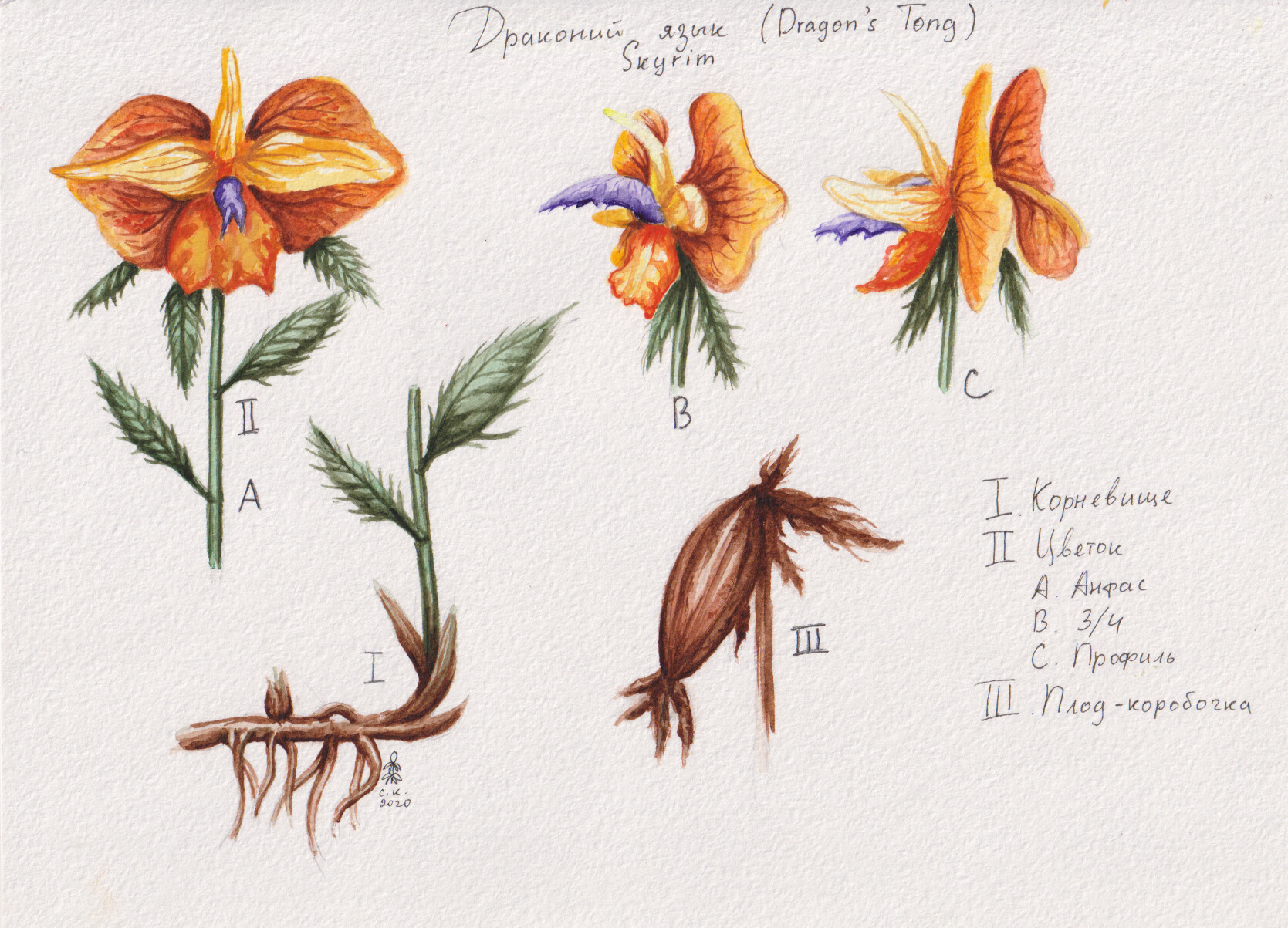
Then there was the dragon tongue. It belongs to the herbaceous plants of the Orchid family, therefore it has a typical root system for them.
And then the Nirnroots went: a Cyrodiil subspecies, it has a bulb, from which leaves grow, and later a pedicel appears. The flower is three-leaved, white. This is a perennial plant, as evidenced by the bulb. It is characterized by the absence of scales, unlike other plants of a similar type. Judging by the ingredient in the game, it is the onion that is used in alchemy, since it most likely contains all the substances characteristic of this plant. Unbranched roots, hard, gray. The fruit is a lot of nuts. (see Skyrim Nirnroot)
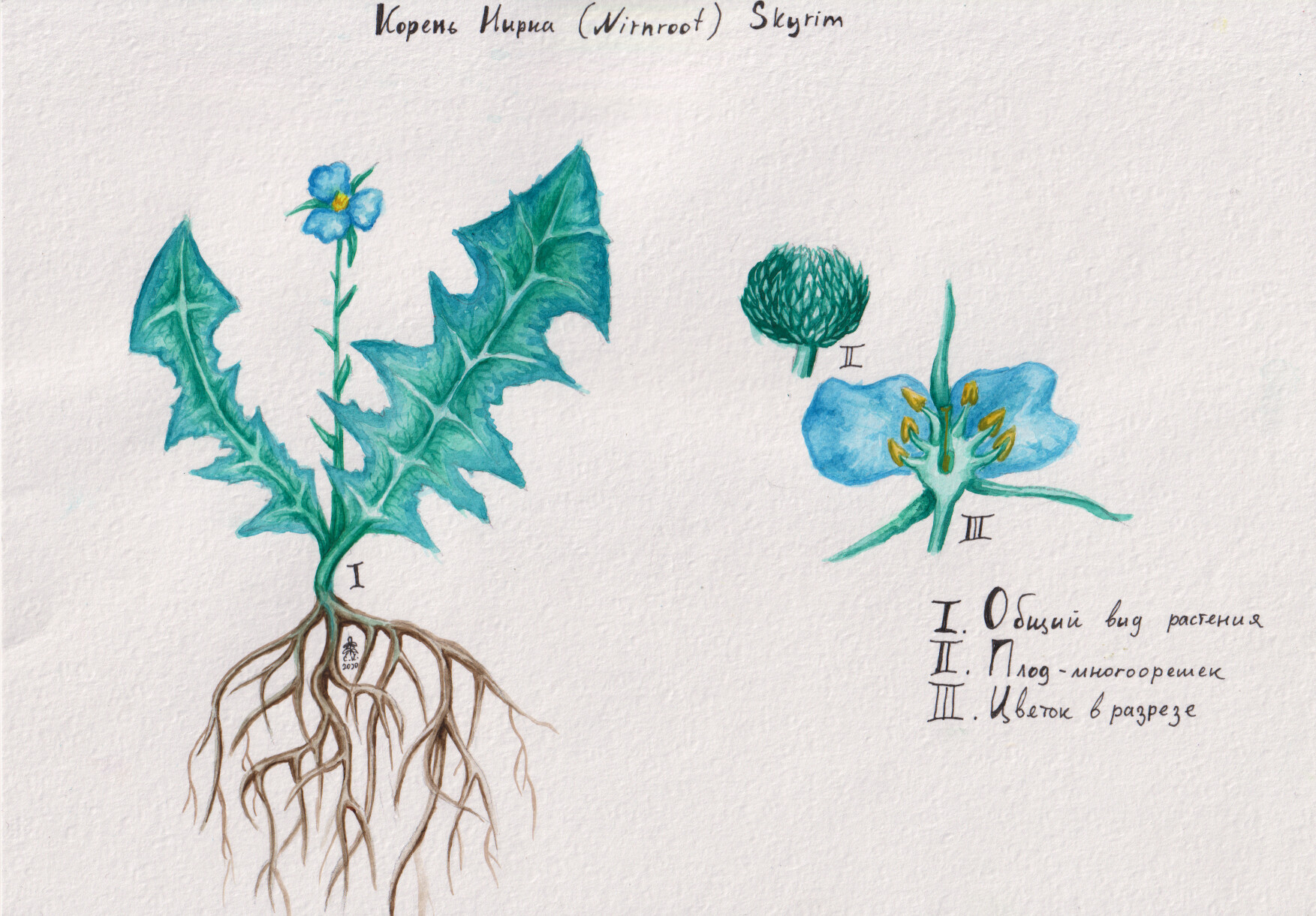
Skyrim Nirnroot. He lacks a bulb, and the leaves are characterized by the so-called xeromorphism, that is, they are dry and tough. This is an adaptation to the northern cold - the less water there is in the leaves, the less likely it is to turn them into thorny crystals that destroy plant cells. Leafy pedicel. The flower is blue. The fruit is a multi-nut.
Scarlet Nirnroot of the Black Reach. The main difference is red. Most likely this is an adaptation to a poor spectrum of light in the Black Limit. Since there are mainly rays of the blue-violet spectrum, it is them that this root absorbs, and reflects the red ones. I decided to make a whole inflorescence for him, with self-pollinating flowers, since there are no pollinating insects, but somehow it is necessary to reproduce. The fruit is also multi-nut, but with fewer fruits. Each of them has a greater amount of nutrients, which means there is a greater likelihood of new plants taking root in such unfavorable conditions.
Draggle-tailfrom Morrowind. Judging by the small amount of chlorophyll (green color) and the number of leaves, this plant is a semi-parasite. With its sucker-root (haustoria), it sticks to the roots of another plant, presumably a water lily, and receives nutrients from it. The bud, which locals call the "ampulla pod", has no leaves, and is formed by the nutrients obtained from the host plant. When a flower (Koda flower) opens, leaves appear, which synthesize the necessary substances for the formation of a fruit - berries, and after its ripening they dry out. Most likely this plant is pollinated by insects, since the pistil extends beyond the flower, and the stamens are inside, this is protection from self-pollination.